Imagine a world where every treatment decision in cancer care—from the design of the trial to a patient’s course of therapy—is informed by comprehensive intelligence.
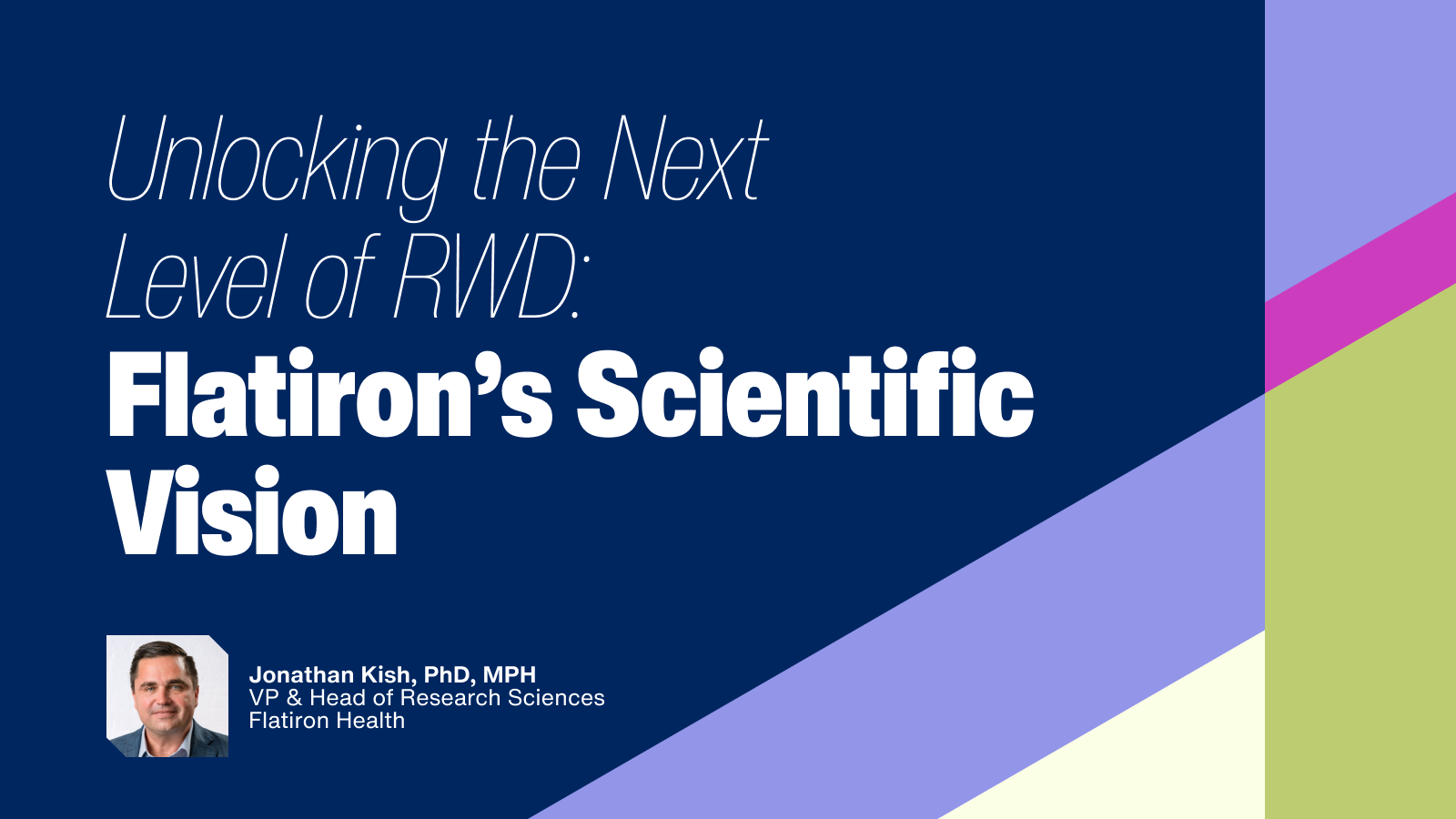
As VP and Head of Research Sciences at Flatiron Health with over 20 years of experience generating real-world evidence, I’ve seen research using real-world data grow and mature, from simple descriptive insights to a “symphony” of understanding derived from complementary information. Over the past year, my team’s breakthroughs have convinced me that we’ve reached the next fundamental inflection point, with recent advances in AI only adding to what’s possible.
For those like me, who came to real-world data in the early 2000s—the “claims era”—this was the first movement of the data symphony: a foundation built on scale, but limited to retrospective, descriptive, superficial and static evidence. The second movement followed with the rise of electronic health record data, adding clinical depth but still leaving much of the story fragmented and difficult to operationalize.
Today, we are entering the third movement…the tools available to us now are powering decisions across the lifecycle of developing and launching a molecule to the provision of personalized clinical care. This movement may allow clinicians to combine molecular biology, clinical and demographic characteristics, and the lived experience of their patient to confidently predict which patients will respond to which treatments. For drug manufacturers, approaches to engagement across the clinical ecosystem can be tailored to the specific needs of the treating physician and their patient. And for regulators, contextual and even direct evidence can be generated in days (not months) to examine safety signals, contextualize the results of a clinical trial, or understand the real-time standard of care within a geography.
At Flatiron, we are conducting this symphony everyday. Between access to millions of real-world patient records and computational tools that didn't exist five years ago, we have unprecedented ability to integrate genomic, clinical, and outcome data at scale. The opportunity is combining the science, the expertise, and the methodological rigor to transform that high-fidelity data into the clinical intelligence that oncology needs.
We believe this is the defining opportunity in evidence generation for the next decade and we're focusing our scientific organization on solving it. I’m excited to share more on where we will be focusing our research teams and scientific efforts this year:
Emerging Clinical and Methodological Questions
Flatiron’s high-fidelity real-world data has the potential to answer critical questions on how patients are responding to novel therapies worldwide, and the role of the resulting evidence is only growing. I see Flatiron excelling in conducting applied, decision-oriented, real-world studies that use both our US or ex-US scaled datasets to address emerging questions globally across the drug development lifecycle.
For clinicians, this work will focus intentionally on how new therapies, biomarkers, and treatment paradigms affect patient outcomes in routine practice—rather than on descriptive characterization of treatment patterns or disease landscapes. These are not questions that traditional clinical trials alone can answer.
In the second movement of our symphony, around the time of Flatiron’s founding, treatment decisions in diseases like multiple myeloma were relatively constrained—often centered around a single dominant therapy such as lenalidomide. Today, clinicians are navigating triplet and quadruplet regimens, where each additional agent multiplies the number of possible combinations and sequences. What was once a linear decision has become a rapidly expanding, multidimensional one. This shift fundamentally changes the evidentiary challenge. Understanding which patients benefit from which therapies across combinations, sequences, and real-world heterogeneity requires methods capable of generating credible, decision-grade evidence outside the constraints of randomized trials.
A recent example presented at last year’s American Society of Hematology Annual Meeting used Flatiron’s real-world data to evaluate the role of measurable residual disease (MRD) in routine multiple myeloma care. The analysis showed that MRD status is strongly associated with key outcomes like time to next treatment and overall survival, while also reflecting the impact of increasingly complex combination regimens. These findings underscore how emerging clinical signals like MRD add an important layer of insight—helping clinicians interpret response, contextualize treatment effectiveness, and make more informed, guideline-concordant decisions in a rapidly evolving therapeutic landscape.
Methodologically, we’re advancing fit-for-purpose causal inference and analytical approaches that can address confounding, selection bias, and time-varying treatment dynamics—expanding how real-world evidence is generated and applied across development, commercial, and clinical decision-making contexts. We believe in a future where decisions are more informed, more transparent, and increasingly resilient to bias and confounding.
Prognostic and Predictive Insights
Oncology generates some of the richest and most complex data in medicine. The rapid expansion of treatment options alongside increasingly granular molecular and genomic data is not simply adding complexity; it is filling in the previously unobserved dimensions of cancer care. What once appeared as noise or variability is increasingly revealed as a signal.
A recent example presented at ESMO AI & Digital Oncology Congress used Flatiron’s real-world data to develop digital twin models predicting survival in advanced non–small cell lung cancer. By incorporating LLM-extracted clinical context, such as autoimmune comorbidities and physician-documented reasons for treatment decisions, the study captures dimensions of care that were previously unobserved in structured data. These signals meaningfully improved patient-level outcome prediction in a setting with rapidly evolving standards of care, demonstrating how predictive and prognostic insights can move beyond static variables to reflect the true complexity of clinical decision-making
While predictive methods have existed for decades, only recently has the combination of large-scale, longitudinal clinical data and advances in machine learning and causal modeling made it possible to apply them meaningfully in oncology. In earlier movements of the symphony, large portions of the patient journey were effectively unmeasured. And what cannot be measured cannot be understood—nor predicted. Today, as these gaps are closed, oncology is beginning to resemble other predictive domains: not because it is simpler, but because it is more fully observed.
Flatiron is using our 15 years of experience in structuring this complexity to build the next future of predictive and prognostic insights. Making these data actionable in real-world oncology requires not just algorithms, but rigor in how data are curated, structured, and analyzed. We can now start to prognosticate about how a patient’s disease is likely to progress and predict how that trajectory may change under different treatment choices. This will provide key strategic evidence to inform decisions at the point of care and along the drug development pathway, from clinical development through post-marketing utilization.
Building on our earlier research demonstrating that real-world data and AI can accurately predict patient outcomes, our latest work advances this foundation in two important ways. In work to be presented at the ISPOR Annual Meeting, we developed and compared multiple digital twin modeling approaches to generate patient-level counterfactual predictions—estimating how outcomes may differ under alternative treatment strategies. Extending this further, we’ll be sharing research at the American Society of Clinical Oncology (ASCO) Annual Meeting this June that validates these predictions against randomized clinical trial data in non-small cell lung cancer, demonstrating close alignment with observed outcomes and treatment effects. Together, this progression—from prediction to rigorous validation—marks an important step toward using real-world data–derived models to inform clinical development and optimize how new therapies are evaluated.
Clinical Decision Intelligence
It’s hard to count how many times I’ve been asked if we can learn from the “unstructured clinical notes” to access deeper insights into the relationships between clinical factors and the treatment decision-making process. Well in this third movement of the symphony, we’re finally able to use advanced AI methodologies and LLM capabilities to derive insights from these notes—extracting physician reasoning, sentiment, and decision drivers. It's about understanding not just what clinicians do, but why, using the clinical reasoning that informs treatment decisions to bridge the gap between evidence and practice. What we call “Physician Insights” represents one expression of this capability; more broadly, this engine enables systematic analysis of decision-making embedded within real-world clinical care. This work will generate interpretable and scientifically sound insights that inform clinical strategy, commercial decision-making, and expand the inputs to the practice of evidence-based medicine.
This level of intelligence requires more than data. It requires expertise in epidemiology, biostatistics, deep learning, and clinical science—our own internal symphony—to perform in concert. And so far we’re seeing promising returns on this investment. We’ll be sharing more on this front at the ASCO Annual meeting this June, including an exciting poster using a large language model (LLM)-based thematic analysis of landmark clinical trial discussions and factors influencing their real-world adoption.
The through-line: Expertise, Science, and Innovation
The third movement of our scientific symphony—decision-focused real-world evidence studies, predictive outcome models, and clinical intelligence extraction—represent how Flatiron is advancing the field's ability to develop real (not artificial) intelligence from real-world data. They share a common foundation: Flatiron's highest-quality real-world data products, our internal expertise in clinical data and research sciences, and our commitment to methodological innovation to achieve our mission.
For the customers, regulators, and partners we serve, this scientific strategy translates to:
- Faster, more credible evidence generation that accelerates development timelines and regulatory decisions
- Research which allows Insights to lead to robust decisions, not just publications
- A rigorous AI/ML frameworks grounded in quality and validity, not hype
- Thought leadership that impacts patient outcomes, not just observations
This is the next movement in our symphony; it isn't a departure from Flatiron's mission to improve and extend lives by learning from the experience of every person with cancer, it's an evolution. Science at Flatiron is bold, rigorous, and relentlessly focused on decisions that matter. For 2026, we're committed to publishing our thinking and maintaining a scientific presence at industry conferences like ISPOR, ASCO, ESMO, as well as tumor-specific opportunities like ASCO GU, WCLC, ASH and SABCS.
If you're working on any of these questions—whether as a regulator designing new evidence standards, a biopharma company building better development strategies, a health system trying to implement precision medicine, or an academic institution advancing the field—we'd welcome the conversation.
To learn more about Flatiron's approach to real-world evidence, visit flatiron.com/real-world-evidence. To explore our published research, visit flatiron.com/publications.