When building a comparative effectiveness study or modeling long-term survival, health economics and outcomes research (HEOR) teams face a familiar problem: treatment pattern data derived from electronic health records (EHRs) tells you who the patient is clinically, and what happened, but historically not why.
Over the past decade, real-world evidence has become an integral part of the drug development lifecycle, from discovery through approval and post-marketing settings. Yet for all their richness in documenting patient diagnoses, treatments, and outcomes, real-world datasets (RWD) have offered limited insight into one critical dimension: physician decision-making. Why does a clinician choose one therapy over another? To what extent are those decisions shaped by clinical factors versus patient preferences, beliefs, and approaches to care?
To fill this gap, researchers have traditionally turned to qualitative methods and patient preference studies — physician surveys, interviews, manual chart reviews, and discrete choice experiments. But many of these approaches introduce their own limitations:
- They rely on self-reported data prone to bias;
- They can’t capture real-world patient heterogeneity; and
- They can struggle to fully reflect the high-dimensional nature of decision-making at scale.
This is where Flatiron’s newest service offering changes the landscape, delivering rapid, actionable understanding of clinical decision-making and prescribing behavior at scale.
How AI-enabled extraction of unstructured EHR data is transforming HEOR research questions
Flatiron's newest service offering taps into industry-leading, regulatory-grade datasets to surface the clinical, contextual, and patient-driven factors in the patient journey. This solution is built on partnerships with hundreds of care centers around the world (both large academic medical centers and local community clinics) and thousands of providers, drawing insights from over 5 million cancer patients and 15 million yearly visits across 22 tumor types to move beyond the “what is” to uncover the “why”.
The challenge in asking “why” a decision was made is that the answers tend to be buried in physician notes that aren’t easily accessible within the EHR. Each one of the over 2 billion clinical notes updates per year provides an opportunity to see into the rationale behind each decision. To extract meaning from these data at that scale, we developed a specialized suite of in-house tools powered by carefully trained large language models (LLMs) to identify meaningful words and phrases in those charts and map them to important decision-driving themes curated by a panel of clinical experts. This delivers objective, real-time insights at scale, not based on perception or recall like traditional market research, but grounded in actual clinical behavior.
For example, a note expressing concern about side effects may be categorized under toxicity considerations, while a mention of travel limitations may be classified as a logistical barrier. Importantly, the results are de-identified and the system extracts themes, ensuring that no protected health information (PHI) or patient or provider identifiable data is exposed at any stage.
Finally, all outputs are rigorously validated against established benchmarks because LLMs are great for scale, but not if it means sacrificing data quality.
What new research questions does this solution unlock?
By surfacing the “why” behind clinical decisions, this solution opens up an entirely new class of research questions. HEOR teams can:
- Identify evidence gaps faster and prioritize studies that address the most pressing provider concerns
- Understand key clinical and non-clinical factors related to physician choice between comparable therapies to refine product positioning and the value story
- Uncover barriers to optimal care delivery—including access, logistics, and patient preferences—to inform provider education
- Identify variation in decision-making across providers and patient segments to better support scientific engagement
Researchers can gain a clearer view into how physicians interpret clinical evidence, perceive new therapies or trials, and weigh concerns around toxicity, efficacy, and patient suitability. Just as importantly, these insights can be segmented across critical dimensions — like tumor subtype, disease progression, patient demographics, and care setting — allowing teams to translate findings directly into more refined research and engagement strategies.
Ultimately, we designed this solution to bring much-needed context to real-world treatment decisions — equipping life sciences researchers with the insights they need to close gaps in care and answer the questions that matter most to their cross-functional partners in medical affairs, market access, and commercial to ensure more patients receive the right treatment at the right time.
Closing the gap between eligibility and treatment
Consider CAR-T cell therapy. It represents a major breakthrough for patients with hematologic malignancies such as diffuse large B-cell lymphoma (DLBCL) and multiple myeloma (MM), particularly for those who have already undergone multiple lines of therapy and are facing relapsed or refractory disease. Yet despite its promise, only about a quarter of eligible patients receive the treatment.
Why does this gap exist? In a recent analysis of approximately 2,000 DLBCL patients treated with two or more prior lines of therapy, we found that a range of factors contribute to attrition before treatment delivery. Clinical considerations such as patient frailty, comorbidities, and rapid disease progression play a role. But so do operational hurdles, including the complexities of apheresis and manufacturing timelines.
Importantly, the barriers are not purely clinical or operational. Socioeconomic and logistical factors (such as cost, travel burden, and availability of caregiver support) can significantly influence whether a patient moves forward with treatment.
These data were previously unavailable at scale from claims or structured EHR datasets until now. When these narrative insights are systematically extracted, they allow researchers to connect patient journey data with physician reasoning, providing HEOR teams with evidence that can inform provider education, patient, and market access strategies:
- Identify why dropout occurs along the CAR-T treatment pathway
- Understand the mixture of clinical and care delivery factors influencing referral decisions
- Support HEOR evidence generation demonstrating real-world treatment barriers
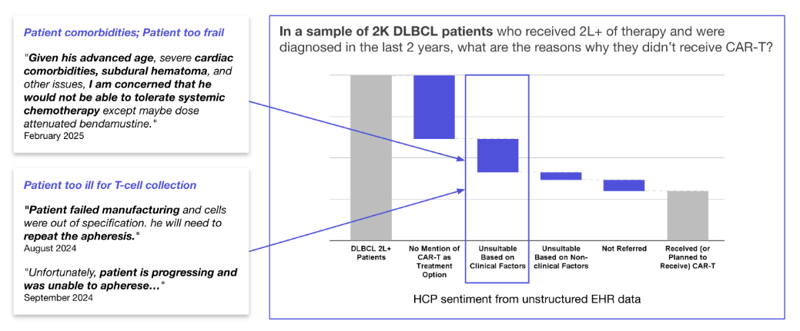
Note: Illustrative example with representative quotes and outputs
CAR-T is not an isolated case. Across many advanced therapies, the gap between eligibility and treatment remains substantial. While some barriers are unavoidable, others — particularly those related to logistics, access, and education — are addressable. The first step is understanding them. We developed this solution to help our research and life sciences partners find answers.
Why this matters now
The oncology landscape is at an inflection point. Scientific innovation is accelerating, but access and adoption are not keeping pace. With many advanced therapies like CAR-T, the gap between clinical potential and real-world utilization remains significant. Closing it will take more than better data — it will require a deeper understanding of the decisions that shape patient care.
RWE is entering a new era, one where context should be delivered alongside outcomes. This solution is at the forefront of that evolution, transforming unstructured clinical narratives into actionable insights at scale.
If you’d like to explore how this exciting new Flatiron service can support your evidence strategy, please reach out.
.png)