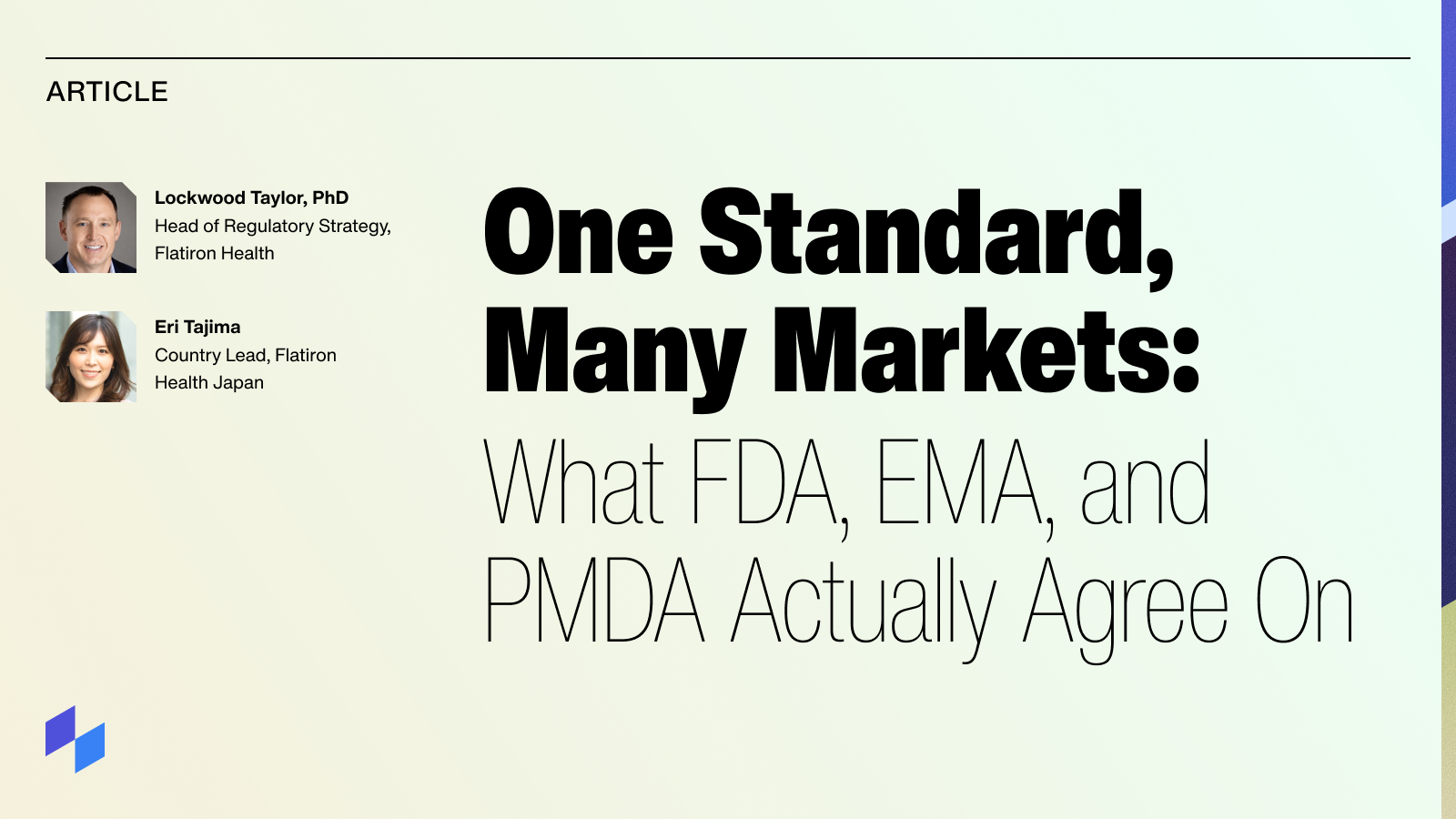
As precision medicine accelerates and oncology care becomes more complex, the importance of real-world data in regulatory decision‑making is growing globally. Eri Tajima leads Flatiron’s work in Japan, where she has spent years helping sponsors and regulators work through what high-quality real-world data looks like in practice. Lockwood Taylor leads global regulatory strategy for Flatiron, with experience spanning FDA, EMA, and other health authorities. Over the past several years, they have sat in different rooms, in different countries, hearing essentially the same conversation, and they have watched sponsors repeatedly run into the same misunderstanding about what it takes to get real-world evidence across the regulatory finish line.
The common misconception is worth naming directly: building a real-world dataset appropriate for regulatory use is not a data management exercise. You are building infrastructure with traceable provenance, validated extraction methods, and QC protocols that are pre-specified, and the entire system has to hold up under regulatory scrutiny from the moment data exists to the moment it appears in an evidence package.
What everyone agrees on
If you put FDA guidance, EMA’s Data Quality Framework, PMDA’s published standards, and ICH E6(R3) Annex 2 side by side, the alignment is hard to miss. Each has quietly converged on the same organizing principle for RWD in regulatory use: fit-for-purpose, evaluated through three universal pillars—accuracy, completeness, and traceability. In this setting, fit-for-purpose is identified by the specific research question you are trying to answer, the role the data is expected to play in the decision, and the degree of uncertainty regulators are willing to accept given what you can reasonably know about the source population, the variables available, and the methods used to extract and validate them.
This thinking is demonstrated widely:
- In March 2026, a white paper was published as part of a research project funded by Japan’s Ministry of Health, Labour and Welfare, which was led by Dr. Hideaki Bando at the National Cancer Center Hospital East (NCCHE). The paper was co-authored by a collaborative team of academics who work closely with PMDA and pharma industry representatives, including Eri herself. The paper confirms our perspective, comparing PMDA, FDA, EMA, and ICH E6(R3) requirements, finding that reliability means largely the same thing no matter which agency you are standing in front of, and fit-for-purpose is the framework all of them use to decide whether a given dataset meets the bar for a given question.
- And, we’ve also seen independent work also reach similar conclusions on narrower comparisons. A poster at ISPOR Europe 2025 compared FDA’s QCARD framework directly against EMA’s Data Quality Framework and found real alignment between the two, not just in high-level principles but for how evaluators are expected to think about documentation, traceability, and the link between data quality dimensions and the fitness of the evidence for its intended use.
- Finally, International Council for Harmonisation's November 2025 concept paper on RWE harmonization suggests this convergence is now being formalized at the international level, which tells us this is not a handful of researchers noticing the same thing in isolation, more so it is becoming the shared vocabulary of the field.
For sponsors, this is a genuinely useful signal, because it changes how you should think about global evidence strategy. The rigorous work of building a fit-for-purpose evidence package for one agency does not get thrown away when you move to the next, provided you have documented your reasoning, your QC, and your limitations in a way that another reviewer can follow.
Where Japan does things differently
While the principles line up closely, Japan's regulatory landscape still has structural differences that sponsors new to the ecosystem often do not see.
Adoption of RWE is growing among Japanese sponsors and there are significant opportunities to capture its broader value across the development lifecycle. Key areas with immense potential for further expansion include natural history studies, trial contextualization, and early-stage development planning. HEOR is already one of the more active use cases for RWD in Japan, with many dedicated HEOR divisions, although mainly claims data has been used due to the lack of meaningful EHR-based RWD in Japan historically. Additionally, post-marketing commitments and requirements, known locally as post-marketing surveillance, are another area where the use of RWD via post-marketing database studies has been increasing.
One framing that does not translate as directly is diversity planning. It is a common lens in US regulatory conversations, but Japan’s patient population is largely homogeneous, so the value proposition for RWD has to be built on different terms—often data collection methodology, generalizability within the Japanese clinical context, and the ability to characterize real-world treatment patterns.
The REALISE study is a useful illustration of why this local context matters, because it shows what happens when three credible sources get compared on the same clinical question without assuming they will tell the same story. Researchers compared Flatiron RWD, the SCRUM-Japan registry, and ARCAD clinical trial data head to head and found that differences in the underlying data generation processes were reflected in observed differences in overall survival and progression-free survival outcomes across the three sources. Those differences largely traced back to data collection methodology, patient consent timing, and potential unmeasured confounders, which are exactly the kinds of issues regulators care about when they ask whether a dataset is fit for purpose for their specific use case. Specifically, Flatiron’s ability to extract unstructured data from the EHR enabled more complete data in key variables like biomarker status and ECOG performance score, metrics that have immense influence on patient survival. The improved completeness of Flatiron’s data, one of the three pillars of assessment for the FDA, EMA, and PMDA, supports more robust analyses and a wider range of fit-for-purpose use cases by enabling clearer cohort definitions, reducing missingness-driven uncertainty, and strengthening the generalizability of study findings to the overall patient population, thereby supporting the fitness of RWD for regulatory applications.The US and EU worked through these same questions as their RWE ecosystems matured, and Japan is building that experience base now. That is a natural part of any ecosystem’s growth, not a shortcoming, but it does mean sponsors should expect to explain their source selection and their sensitivity analyses with notable rigor.
What this means for global sponsors
Put these two stories together and a useful strategic picture emerges, one that is more nuanced than either “global harmonization is solved” or “every market is completely different.”
Convergence means sponsors do not need to build an entirely new evidence package from scratch for every agency. A rigorous fit-for-purpose assessment, built around accuracy, completeness, traceability, and relevance to your specific research question functions as common currency across FDA, EMA, and PMDA.
Divergence means that the same assessment cannot simply be relabeled for PMDA without adaptation. Japan’s registry-first culture, reflected in PMDA’s registry-focused guidance for regulatory submissions and its three registry consultation pathways (utilization, use‑plan, and reliability consultations), and its still-evolving stance on EHR-derived data all call for genuine local expertise.
In practical terms, the sponsors who do well here document their fit-for-purpose reasoning while the study is being designed, they treat QC and provenance as submission content, and they plan for the possibility that a reviewer in Tokyo will ask different follow-up questions than a reviewer in Amsterdam. That is not a reason to build three separate programs. It is a reason to build one strong program with enough flexibility to support local consultation and local source context.
What helps most is working with a partner who has operated inside all three regulatory environments and has the submission track record to show it. Evidence from Flatiron data has supported 45 regulatory submissions across FDA, EMA, Health Canada, TFDA, MFDS, and PMDA, along with 15 PMC, PMR, and PASS studies. That cross-agency experience reflects a level of engagement with regulatory science that goes beyond supplying data for someone else’s package.
For Japan specifically, we've heard interest from clients in the regulatory submission of Flatiron's Japanese RWD, shaping how we think about regulators' expectations around RWE are headed next, including how sponsors should prepare for questions that sit at the intersection of data access, rigorous data processing, and inspectability. We built our RWD approach around longitudinal datasets that trace back to the original EHR because that is what regulatory use cases in Japan have demanded, and we expect those demands to increase as EHR-based RWD becomes more available and more sponsors move beyond claims-only strategies.
As AI-extracted data becomes more prevalent in submissions globally, the same quality principles will apply, and Flatiron’s VALID Framework offers sponsors a concrete way to show that an extraction method was evaluated against a reference standard rather than assumed to be accurate because the model performed well on a test set. That forward-looking consideration belongs in partner selection conversations now, not after the first submission that relies on LLM abstraction lands on a reviewer’s desk.
The global regulatory conversation about RWD quality is moving faster than many sponsors may realize. The frameworks are converging, which is good news. The local expertise required to navigate them well still varies quite a bit from market to market, and that is simply the nature of a maturing field. The sponsors who will win are the ones who start building their data quality story early, think globally from the outset, and partner with people who have already spent time in the room.
If you are thinking through what it takes to build an evidence strategy that holds up across FDA, EMA, and PMDA, we would welcome the conversation.
If you're interested in a deep dive on optimizing European HTA submissions with global RWD, join us on July 28 for a live webinar, lead by Flatiron’s Arun Sunjenthiran who will be joined by Hillary Keenan, Senior Director, Epidemiology, Global Evidence and Outcomes at Takeda and Karen Facey, Senior HTA Advisor at Universities of Oxford, Utrecht, Edinburgh and RWE4Decisions.