For years, data teams have lived by a simple warning: garbage in, garbage out. At IMPACCT RWE 2026, Michael Bierl, Chief Business Officer at Flatiron Health, offered an updated version for the age of AI: garbage in, gospel out.
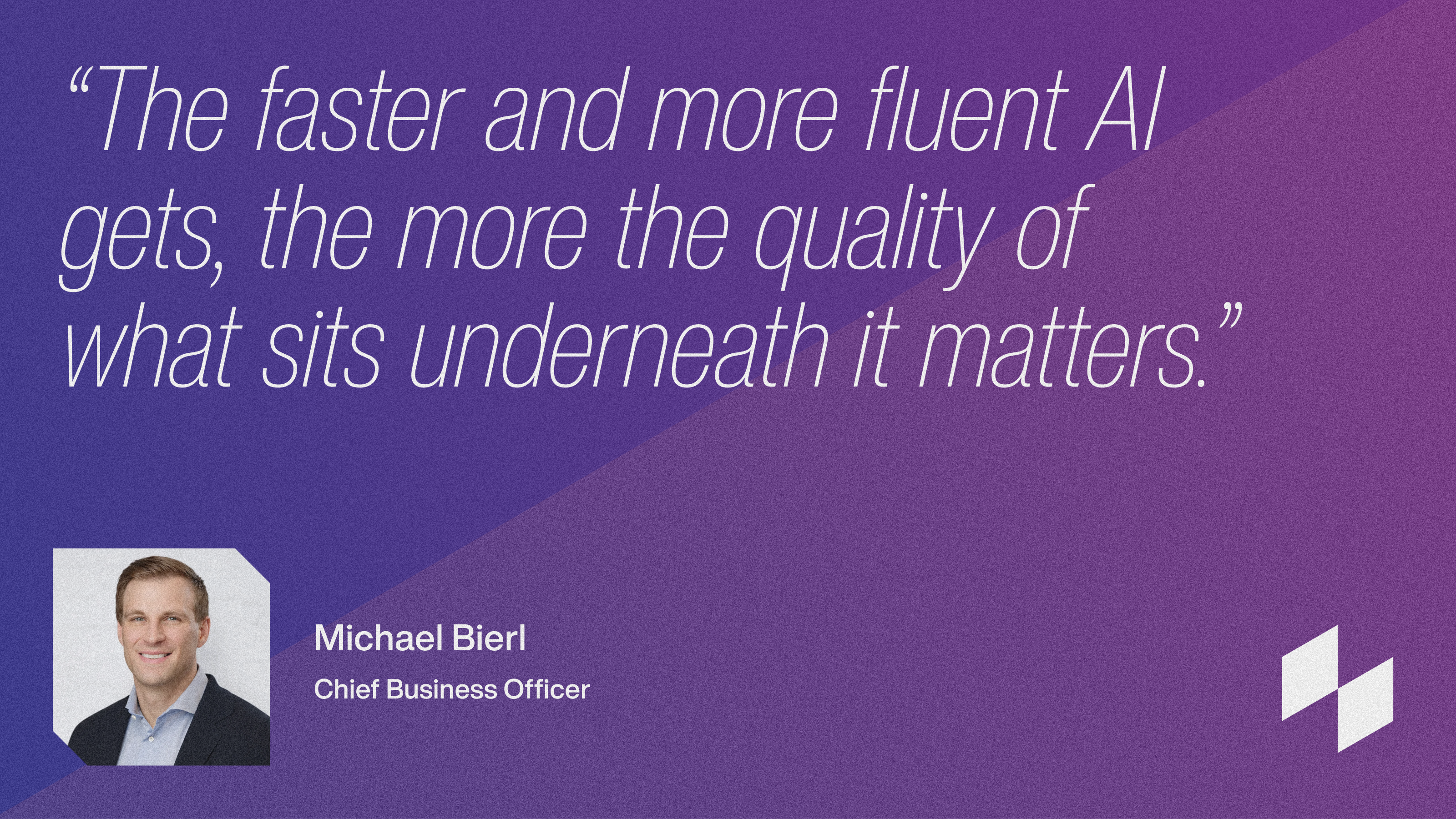
The difference is that AI doesn't just reproduce flawed data. It can turn it into a polished, confident, fast answer that looks like the truth. A bad assumption in a dataset no longer produces an obviously bad result that someone catches. It produces a fluent analysis, a clean-looking report, and a conclusion that people are inclined to trust. The faster and more fluent AI gets, the more the quality of what sits underneath it matters.
That idea ran through two days of conversation at the 14th IMPACCT RWE summit in Boston, which brought together leaders in evidence generation, medical affairs, HEOR, epidemiology, and data science from across pharma and biotech. The question on everyone's mind: how do we use AI to close evidence gaps faster without giving up the scientific rigor that makes evidence worth acting on?
Flatiron Health was proud to participate as a panel partner. Michael joined leaders from Astellas, Bristol Myers Squibb, Novo Nordisk, Takeda, and AI4Purpose on the main-stage panel: How RWE and AI are shaping R&D and evidence strategy today, from methodology to impact. During the session, Michael shared how Flatiron has been approaching AI across its 6M+ global patient records: training machines to meet the same standard as expert human abstractors, publishing the VALID framework to do it transparently, and building tools like Flatiron Telescope so scientists can spend less time on the mechanics of analysis and more time on judgment.
Across sessions and conversations, three themes stood out:
- Trusted AI requires trusted data
- AI is real, but the efficiency isn't here yet
- The biggest opportunity is expanding the mandate
Here are our key takeaways.
Theme #1: Garbage in, gospel out: trusted AI requires trusted data
Michael made the point while the panel was discussing governance. AI can now produce ever more output at ever greater speed, so the focus has to return to what powers it: the data and the assumptions built into it. If those assumptions are flawed, faster AI simply scales the mistake.
His example came from breast cancer. For patients with metastatic breast cancer, a CDK4/6 inhibitor is commonly prescribed alongside endocrine therapy, but the two drugs don't always start together. In the US, Flatiron observed that insurance delays could mean patients began the CDK4/6 inhibitor weeks after endocrine therapy, even when both were intended as one treatment regimen, and adapted its approach to identifying lines of therapy accordingly. But in other countries, such as the UK, differences in care pathways, prescribing, and treatment access may lead to different patterns of treatment initiation. An algorithm built around US clinical practice can't simply be assumed to accurately represent care in another healthcare system.
The antidote is what Flatiron calls data empathy: a deep understanding of how data was captured, how the patient journey was reconstructed, and how variables and data models were built. As AI scales outputs, that understanding separates evidence that is defensible from evidence that is simply fast.
Other speakers echoed the point with their own version, "quality in, quality out," warning that fluent AI output can hide flawed logic. Flatiron's VALID framework addresses this directly, verifying that LLM-extracted EHR data aligns with expert human abstraction, makes clinical sense, and can replicate established clinical findings. In a world of garbage in, gospel out, that governance is what lets teams trust the answer, not just receive it.
Theme #2: AI is real, but the efficiency isn't here yet.
Teams have moved well past pilots. AI is now a daily copilot for programming, protocol drafting, literature review, and study design, and agentic tools are arriving fast. But expectations are outrunning results.
AI can shorten the time to a first draft, but reviewing and validating the output takes real time, so the finished study is often not much faster. The bottleneck is shifting from execution to review and governance, and a report generated in minutes can look like complete research without the scientific judgment behind it. Teams making progress are redesigning how work gets done rather than bolting tools onto old processes, and bringing epidemiologists into the build from day one.
Meanwhile, the market is extremely saturated with organizations claiming to produce similar outputs. Data providers, technology companies, and internal teams are all building AI tools, and the pitch is converging: transparent logic, inspectable code, audit trails, and alignment with emerging validation frameworks. Those are quickly becoming table stakes. When every tool promises faster answers, speed stops being the differentiator.
Michael's answer on the panel was to reframe the goal, starting with amplifying RWE teams. With tools like Flatiron Telescope, Flatiron’s AI-powered continuous oncology intelligence engine, a scientific director can have a team of research assistants: AI handles the minutiae of analyzing the data through natural language, while scientists focus on judgment, oversight, and steering the work. Epidemiology is the arbiter, and technology is the amplifier.
Theme #3: Expanding the mandate: from what happened to why, and from retrospective data to predictive modeling
Michael's closing message to the room was to expand the mandate. If the industry only uses AI to do the same work faster and cheaper, efficiency becomes a self-fulfilling goal. The bigger opportunity is to ask what teams couldn't do before: moving from retrospective data to predictive RWE, picking up new signals earlier, and supporting a larger part of the drug lifecycle.
Unstructured data is a big part of that shift. Clinical notes hold the context behind treatment decisions, which lets researchers see beyond what happened to why it happened. AI can now turn those notes into analysis-ready data at scale, and Flatiron's governance for extraction, including VALID, makes sure the result is one that teams can trust.
Flatiron is already putting this into practice. For example, a recent Flatiron analysis used LLMs to look at discussions of landmark clinical trials and the factors that influence their uptake in real-world care, the kind of question that was hard to answer at scale before AI could work with unstructured data.
Looking ahead: Bigger questions, built on trusted data
AI is making answers cheaper and faster to produce. That makes the things behind the answer more valuable, not less: data that is deep, well-curated, and understood; validation that is transparent; and scientists who stay in charge of the questions being asked. The organizations that get the most from AI won't be the ones that simply do the same work faster. They will be the ones that expand what they can do, with evidence their stakeholders can trust.
That takes a partner who truly knows their data, the questions it can answer, and how best to answer them. Whether you're planning a study or exploring how AI can accelerate your RWE work, connect with our partnerships team today to explore how Flatiron can support your evidence strategy.