
In oncology, the patients who stand to benefit most from new therapies are often the hardest to study. Niche patient populations defined by specific molecular alterations — like ESR1 mutations in ER+/HER2- advanced or metastatic breast cancer — require real-world data with the clinical depth to actually find them: biomarker test type, test result, mutation status, and the full treatment history that follows.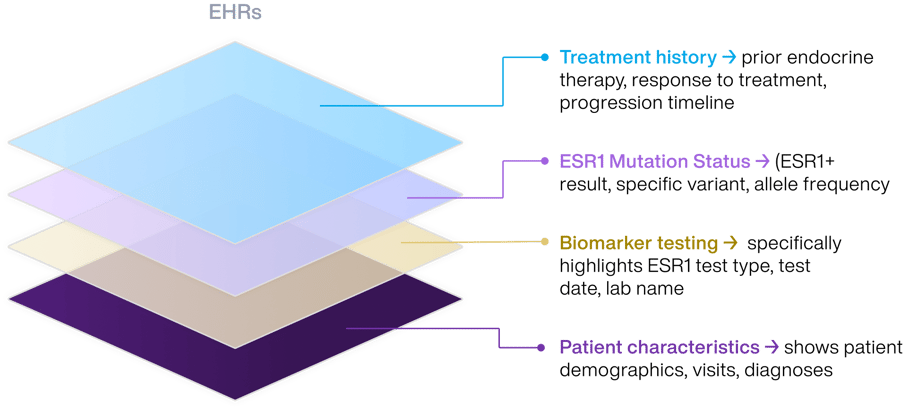
That level of granularity isn't a given. It requires deeply curated, EHR-derived data that captures both structured and unstructured clinical information across the patient journey. A recent HTA recommendation in the UK — leveraging high-fidelity RWD from Flatiron Health and Foundation Medicine in the United States to build relevant external control arms for elacestrant — offers a compelling case study in how that clinical depth can bridge critical evidence gaps, even across borders.
Let’s take a closer look.
The case for elacestrant in the UK
Up to 50% of patients with ER+/HER2- advanced or metastatic breast cancer (a/mBC) acquire activating mutations in the ESR1 gene following prolonged endocrine therapy, and those mutations are associated with significantly poorer outcomes.
As of early 2025, the second line standard of care for those patients in the UK was a combination regimen of everolimus (an mTOR inhibitor) plus exemestane (an aromatase inhibitor), or alpelisib (a PI3K inhibitor) plus fulvestrant (an ER antagonist) for patients with a PIK3CA mutation, but those options showed limited success and were notably difficult to tolerate — leading to high treatment discontinuation among patients, and growing reluctance among clinicians to prescribe them in the first place.
To meet that critical need, Menarini Stemline developed elacestrant, a novel, nonsteroidal, oral SERD therapy, and showed that it was associated with a 41% reduction in the risk of progression or death compared to everolimus + exemestane for patients whose disease continued to progress following at least 12 months of endocrine therapy and a CDK 4/6 inhibitor. In February 2025, the UK’s National Institute for Health and Care Excellence (NICE) recommended it for coverage within the NHS.
Stemline’s submission to NICE was notable for two reasons: it relied on external evidence for comparative analysis, and it drew on real-world data from the United States — not the UK — to construct that arm. Why?
High-fidelity RWD can fill critical gaps in local evidence
EMERALD — the global Phase 3 trial underpinning the 2023 FDA approval of elacestrant — compared the new therapy against endocrine monotherapy (such as fulvestrant, anastrozole, letrozole, or exemestane as single agents), rather than the combination regimens commonly used in UK clinical practice. This left a critical evidence gap. UK HTAs require evidence that directly addresses a UK-specific PICO; Population, Intervention, Comparator, and Outcome. As the trial's comparator was misaligned with UK practice, the evidence needed to satisfy that framework simply did not exist.
In the absence of head-to-head trials comparing elacestrant with either everolimus plus exemestane or alpelisib plus fulvestrant — and given the urgency of meeting the need for an effective alternative to those relatively toxic regimens — Stemline turned to RWD to bridge the gap between the EMERALD trial population and the UK standard of care.
However, ESR1 mutation testing wasn’t routinely performed by the NHS in the UK at the time of submission, so the team couldn’t build an external control arm for patients with ESR1-mutated a/mBC from UK data. Instead, they turned to high-fidelity, multimodal, US-based RWD from Flatiron Health and Foundation Medicine. This required a few careful statistical adjustments.
Key methodological adjustments
The research team identified 32 eligible patients treated with everolimus plus exemestane in the US-based RWD dataset, 33 treated with alpelisib plus fulvestrant, and compared them to 78 patients treated with elacestrant in the EMERALD trial.
To enable a valid comparison, the team needed to account for differences in baseline characteristics between those populations. Some, like menopausal status, duration of previous CDK 4/6 inhibitor therapy, and ESR1 mutation were implicitly included through study design, but others required explicit adjustments, including age, number of prior lines of endocrine therapy, and prior exposure to chemotherapy. For instance, the elacestrant cohort had a slightly higher proportion of patients who had received one and not two prior lines of endocrine therapy (63% vs. 56%), and fewer had undergone chemotherapy in the metastatic setting (10% vs. 19%).
Without individual patient-level data for the comparator treatments and with no common comparator between the EMERALD trial and the Flatiron dataset — that is, no shared treatment arm linking the two data sources — the team used a statistical technique known as unanchored matching-adjusted indirect comparison (MAIC) to perform the necessary adjustments.
Finally, to address potential confounding related to dual-mutated patients (ESR1 + PIK3CA), it was important for Stemline to demonstrate that the proportion of dual-mutated patients in the RWD cohort (34%) was very similar to that in the EMERALD trial (35%), and that the US and UK treatment pathways were essentially the same for those patients.
Major takeaways for the use of RWE in HTA submissions
With these adjustments in place, the research team was able to generate robust comparative outcomes, demonstrating a clear advantage for elacestrant in both median progression-free survival (7.4 vs. 4.6 months for everolimus + exemestane) and median overall survival (27.7 months vs. 18.0). These results, in turn, supported the cost-effectiveness case submitted to NICE.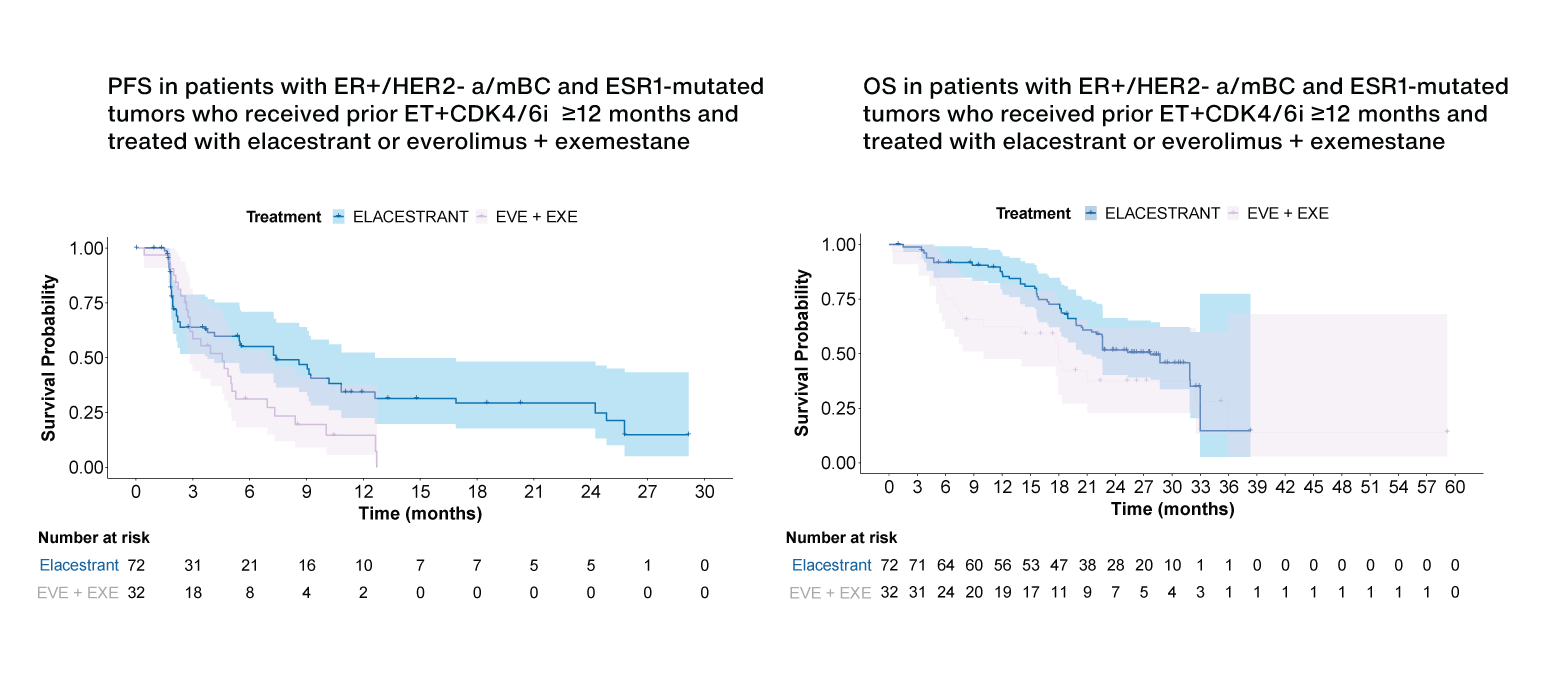
This case study was a highly collaborative effort between Menarini Stemline, NICE’s evaluation committee, and the project’s external assessment group (EAG), and it showed that under the right conditions and with the right partners, innovative biopharma companies can rely on RWD to develop regulatory-grade external control arms for their studies — even when that data originates outside the target jurisdiction. At Flatiron, this is a space we've been deeply invested in for years, having supported partners across more than 30 HTA submissions globally and working directly with bodies like NICE to advance the methodologies that make cross-border RWE credible.
While locally-sourced data is often preferable, it’s not always available, and we’re very encouraged to see HTA bodies willing to take a pragmatic approach to those limitations and recognize the value that high-quality, cross-border RWD brings to the table.
If you’re exploring how to incorporate RWD into your own HTA submissions, our team is here to help.

.png)